As developers, we often find ourselves working with data that needs sifting and organizing. Maximum productivity can be accomplished by filtering and sorting through console outputs effectively. This article will guide you through organizing console outputs using JavaScript to make it more manageable and informative.
Basic Console Output
Before diving into filtering and organizing, let’s start with some basics. The console.log() in JavaScript allows you to print output to your browser’s console, usually for debugging purposes:
console.log('This is a basic message');This is the simplest way to see a message in your developer tools console.
Interpolating and Formatting Messages
JavaScript provides several ways for interpolating and formatting console output:
let name = 'Alice';
let age = 30;
console.log('Name: %s, Age: %d', name, age); // using format specifiers
Formatting helps in sorting log message structures and retrieving meaningful information efficiently.
Group Console Output
To filter and organize console information succinctly, grouping messages can come handy. You can use console.group() and console.groupEnd() to group related logs together:
console.group('User Details');
console.log('Name: Alice');
console.log('Age: 30');
console.groupEnd();
This method helps in minimizing clutter and organizes output neatly for better visibility.
Conditional Filtering with Assertions
console.assert() method outputs a message only when a given assertion evaluates to false:
let loaded = false;
console.assert(loaded, 'Resources failed to load');
Use assertions strategically to avoid unnecessary outputs unless there are errors or unexpected values.
Counting Occurrences
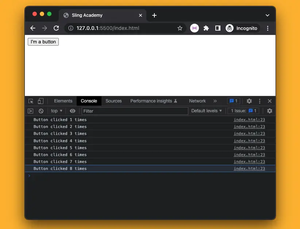
In JavaScript, console.count() keeps track of the number of times a function is called or a certain statement is executed.
function countClicks() {
  console.count('Button Clicked');
}
Counting is useful in understanding events fired or code blocks accessed within your application.
Time Tracking with Console
The console.time() and console.timeEnd() methods aid in performance monitoring and identification of bottlenecks within the code:
console.time('Array initialize');
let array = new Array(1000000);
console.timeEnd('Array initialize');
Checking execution time helps in optimizing processes and improving application performance significantly.
Rendering Tabular Data
For neatly displaying data, console.table() presents output in a tabular structure:
let users = [
  {id: 1, name: 'Alice', age: 30},
  {id: 2, name: 'Bob', age: 25},
];
console.table(users);
Tabular data output improves readability, especially when dealing with complex structures or datasets.
Conclusion
Filtering, organizing, and formatting console outputs in JavaScript can significantly ease debugging and enhance your code exploration experience. By using techniques such as grouping, assertions, count tracking, time measurement, and structured data presentation, you can keep your diagnostics structured and efficient. Master these methods to bring clarity and precision to your development workflow.