NumPy – Making use of ufunc.ntypes attribute (5 examples)
Updated: Mar 02, 2024
NumPy, a fundamental package for scientific computing in Python, provides a wide array of numerical operations. One of the lesser-known but potent features of NumPy is the universal functions, or ufuncs, which allow for fast element-wise......
NumPy – Understanding random.Generator.uniform() method (5 examples)
Updated: Mar 02, 2024
Overview NumPy is a fundamental package for scientific computing with Python. Among its array of features, the NumPy library allows users to generate random numbers, which is crucial for various computational tasks, such as......
NumPy – Using random.Generator.triangular() method (5 examples)
Updated: Mar 02, 2024
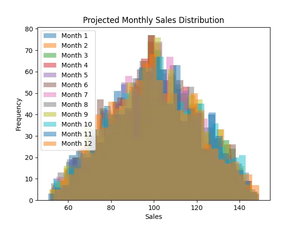
Introduction NumPy’s random.Generator.triangular() method is a powerful tool for generating random numbers following a triangular distribution. The triangular distribution is useful for simulations where you need random numbers......
NumPy random Generator.laplace() method (4 examples)
Updated: Mar 01, 2024
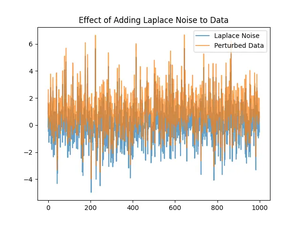
Overview Understanding random data generation, especially with specific statistical distributions, is a fundamental skill in data science. NumPy, a core library for scientific computing in Python, offers an extensive toolkit for random......
NumPy – Using random Generator.lognormal() method (4 examples)
Updated: Mar 01, 2024
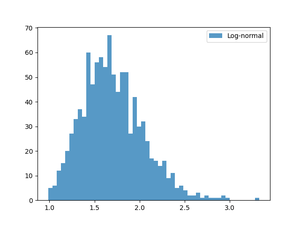
Introduction NumPy, a foundational package for numerical computing in Python, offers extensive support for arrays, mathematical operations, and a rich library of statistical functions. Among these, the random.Generator.lognormal()......
NumPy – Understanding random Generator.logseries() method (5 examples)
Updated: Mar 01, 2024
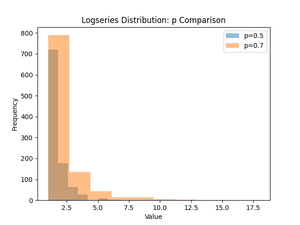
The numpy.random.Generator.logseries() method is a fascinating tool that produces logarithmically distributed samples. This method is particularly useful in scenarios where you need to model phenomena with a high occurrence rate for rare......
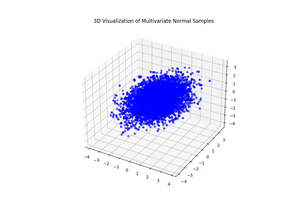
NumPy: Get random samples from a multivariate normal distribution (3 examples)
Updated: Mar 01, 2024
Introduction NumPy, a cornerstone library for numerical computing in Python, offers extensive functionality for random sampling, including the ability to generate samples from a multivariate normal distribution. Understanding this......
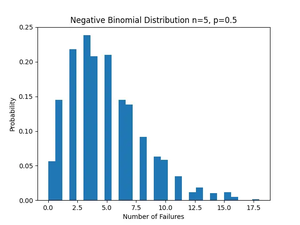
NumPy: Get samples from a negative binomial distribution (4 examples)
Updated: Mar 01, 2024
Overview In this tutorial, we’ll explore how to use NumPy, a fundamental package for scientific computing with Python, to generate samples from a negative binomial distribution. This is particularly useful in various types of......
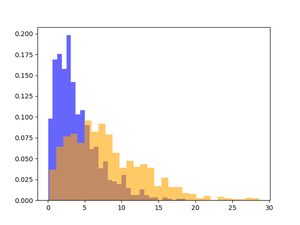
NumPy: Getting samples from a noncentral chi-square distribution (5 examples)
Updated: Mar 01, 2024
Overview The NumPy library is an indispensable tool for numerical computing in Python, providing support for large, multi-dimensional arrays and matrices, along with a collection of mathematical functions to operate on these arrays.......
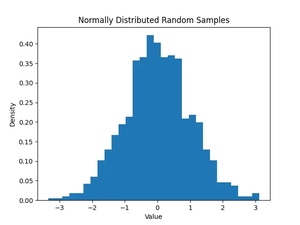
NumPy – Using random.Generator.normal() method (4 examples)
Updated: Mar 01, 2024
Introduction NumPy is a fundamental package for scientific computing in Python. Its wide array of functionalities includes support for multi-dimensional arrays and matrices, along with a collection of mathematical functions to operate......
NumPy – Using random.Generator.power() method (4 examples)
Updated: Mar 01, 2024
NumPy is a core library for scientific computing in Python, providing a high-performance multidimensional array object and tools for working with these arrays. A key feature of NumPy is its ability to generate pseudo-random numbers for......
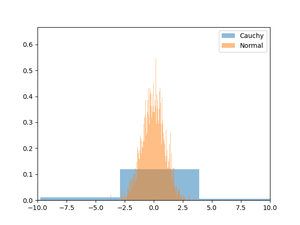
NumPy random.Generator.standard_cauchy() method (3 examples)
Updated: Mar 01, 2024
Introduction NumPy is a fundamental package for scientific computing in Python, offering a powerful N-dimensional array object, various derived objects (such as masked arrays and matrices), and an assortment of routines for fast......