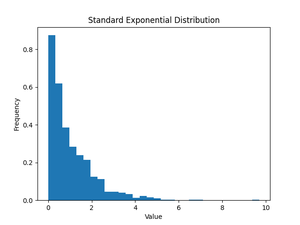
NumPy random.Generator.standard_exponential() method (6 examples)
Updated: Mar 01, 2024
Introduction NumPy, the fundamental package for scientific computing in Python, provides extensive functionality for generating random numbers. One of its features, the random.Generator.standard_exponential() method, allows users to......
NumPy – Using np.gcd() function (5 examples)
Updated: Mar 01, 2024
Introduction NumPy, the fundamental package for scientific computing with Python, offers a vast array of functions for performing mathematical operations. Among these, the np.gcd() function is particularly useful for finding the......
Using np.lcm() function in NumPy (4 examples)
Updated: Mar 01, 2024
Introduction NumPy, a cornerstone library in the Python ecosystem for numerical computations, offers a plethora of functions designed to perform array-based operations with efficiency and ease. Among its vast feature set, np.lcm()......
Understanding numpy.left_shift() function (4 examples)
Updated: Mar 01, 2024
Overview The numpy.left_shift() function, part of the NumPy library, allows users to efficiently shift the bits of an array of integers to the left, a fundamental process in bit manipulation and computer programming. This article will......
Using numpy.logical_xor() function (5 examples)
Updated: Mar 01, 2024
Introduction The numpy.logical_xor() function presents a powerful tool for those delving into data analysis, signal processing, and beyond, by offering a straightforward way to compute the logical exclusive OR (XOR) operation on......
Using numpy.isnat() function (5 examples)
Updated: Mar 01, 2024
Introduction Python’s NumPy library is a cornerstone for those working with numerical data. Among its plethora of functionalities, dealing with dates and time is facilitated by a range of specialized functions. In this tutorial,......
Understanding numpy.copysign() function (5 examples)
Updated: Mar 01, 2024
Overview The NumPy library is central to scientific computing in Python, offering a vast array of functionalities for working with numerical data. One of its less celebrated, yet incredibly useful functions is numpy.copysign(). This......
Understanding numpy.ceil() function (4 examples)
Updated: Mar 01, 2024
Introduction The numpy.ceil() function is a fundamental tool for mathematical operations in Python, especially when dealing with array manipulations within the NumPy library. This function returns the ceiling of the input,......
NumPy: 4 ways to disable future/depreciated warnings
Updated: Mar 01, 2024
When working with NumPy, it’s common to encounter ‘FutureWarning’ or ‘DeprecationWarning’ notifications. These warnings are designed to inform users about changes in the future versions of NumPy that might......
Fixing NumPy ValueError: embedded null byte
Updated: Mar 01, 2024
Understanding the Error The ValueError: embedded null byte error in NumPy is a common issue that can halt your data processing or analysis tasks unpredictably. This error is typically raised when you attempt to use functions that......
NumPy – Using ndarray.dumps() method (4 examples)
Updated: Mar 01, 2024
Introduction NumPy is a fundamental package for scientific computing with Python. It provides a high-performance multidimensional array object, and tools for working with these arrays. A key feature of NumPy arrays is the......
Using ndarray.setflags() method in NumPy (4 examples)
Updated: Mar 01, 2024
Introduction In this tutorial, we’ll explore how to use the ndarray.setflags() method in NumPy, a fundamental library for numerical computing in Python. NumPy arrays come with a set of flags that control various aspects of an......