SciPy cluster.vq.kmeans() function: Explained with examples
Updated: Mar 04, 2024
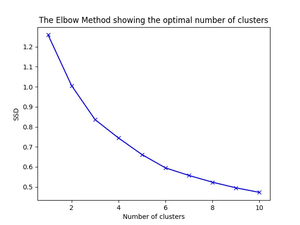
Introduction Clustering is an unsupervised machine learning technique where we group a set of objects based on their similarity. Among various clustering algorithms, K-means is one of the most popular and simplest. The kmeans()......
SciPy: Using cluster.vq.vq() function (3 examples)
Updated: Mar 04, 2024
Introduction Cluster analysis, a staple of data science, involves grouping sets of objects in such a way that objects in the same group are more similar to each other than to those in other groups. In this realm, the SciPy library......
Understanding Scipy cluster.vq.whiten() function (with examples)
Updated: Mar 04, 2024
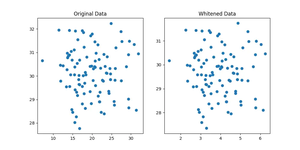
Introduction The Scipy library is a central tool for scientific computing in Python, offering modules for optimization, integration, interpolation, eigenvalue problems, algebraic equations, and more. One of its powerful submodules is......
Using SciPy show_config() function (4 examples)
Updated: Mar 04, 2024
Introduction The SciPy library in Python is an open-source software for mathematics, science, and engineering. It builds on the NumPy array object and is part of the broader ecosystem of scientific computing in Python. Understanding......
An Introduction to SciPy (with basic examples)
Updated: Mar 04, 2024
SciPy is an open-source Python library that is used for scientific computing. It builds on NumPy, offering a wider selection of algorithms for optimization, integration, interpolation, eigenvalue problems, algebraic equations,......
NumPy: Generate variates from a multivariate hypergeometric distribution (3 examples)
Updated: Mar 02, 2024
In this tutorial, we delve into the intricacies of generating variates from a multivariate hypergeometric distribution using NumPy, a foundational package for numerical computing in Python. This type of distribution is crucial in......
Understanding numpy.float16 type (4 examples)
Updated: Mar 02, 2024
In the diverse expanse of Python’s NumPy library, data types play a vital role, especially when dealing with array-based computing and matrix operations. Among these types, numpy.float16 offers a balance between memory efficiency......
Using numpy.negative() function (4 examples)
Updated: Mar 02, 2024
Overview The NumPy library is a cornerstone in the vast landscape of data science and numerical computing within Python. It offers a plethora of functions designed to make mathematical computations more efficient and intuitive. One......
NumPy – Using ndarray.flat attribute (5 examples)
Updated: Mar 02, 2024
NumPy, a fundamental package for numerical computation in Python, provides powerful n-dimensional array objects allowing efficient operations on large data sets. A vital attribute that enhances the array manipulation capabilities in NumPy......
Understanding ndarray.itemset() method in NumPy (3 examples)
Updated: Mar 02, 2024
Introduction The ndarray.itemset() method in NumPy is a powerful tool for setting values within an array. This function is particularly useful when dealing with large, multidimensional arrays, allowing for efficient data manipulation......
NumPy – Understanding ndarray.argpartition() method (4 examples)
Updated: Mar 02, 2024
Overview NumPy, the core library for scientific computing in Python, provides a wide array of high-level mathematical functions to operate on these arrays. Among its powerful features is the ndarray.argpartition() method, a tool that......
NumPy: How to fully print large arrays without truncation (3 ways)
Updated: Mar 02, 2024
In the world of data analysis and scientific computing, NumPy stands as a cornerstone for handling numerical data efficiently in Python. However, when dealing with large arrays, NumPy’s default print behavior often truncates the......