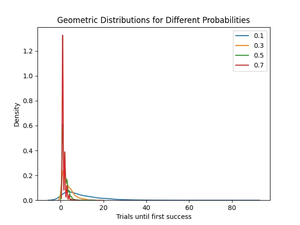
NumPy: Getting samples from geometric distribution (4 examples)
Updated: Mar 02, 2024
Introduction NumPy, a fundamental package for numerical computing in Python, provides extensive support for working with arrays and matrices. Among its myriad of capabilities is the ability to generate samples from various statistical......
NumPy – Using random Generator.permuted() method (4 examples)
Updated: Mar 02, 2024
In the vast arena of numerical computing and data science, NumPy stands as a cornerstone. It fuels the computational engine of Python with array objects, mathematical operations, and a suite of utilities to process numerical data......
NumPy: How to Generate Random Bytes (4 Examples)
Updated: Mar 02, 2024
NumPy, a fundamental package for scientific computing with Python, offers an extensive range of options for generating random data. Among these options is the ability to generate random bytes, which can be useful for a variety of......
NumPy – Mastering char.replace() function (5 examples)
Updated: Mar 02, 2024
NumPy, a fundamental package for scientific computing in Python, offers a vast array of tools for working with arrays. Among its myriad of functionalities, the char.replace() function in NumPy is a specialized tool designed for convenient......
Exploring char.translate() function in NumPy (5 examples)
Updated: Mar 02, 2024
Introduction The char.translate() function within NumPy is a useful tool for manipulating strings at a vectorized level. This guide will explore its capabilities through five progressively complex examples, highlighting the versatility......
Understanding char.index() function in NumPy
Updated: Mar 02, 2024
Overview NumPy, a fundamental package for numerical computations in Python, offers a variety of functionalities for handling arrays and matrices. Among these, the char.index() function might not be widely known or used since it......
NumPy – Using char.find() function (4 examples)
Updated: Mar 02, 2024
NumPy, the cornerstone library for numerical computing in Python, offers a wide array of functions designed to operate on arrays for efficient computation. Among its lesser-known treasures is the char.find() function, a method belonging......
Understanding char.isalpha() function in NumPy (4 examples)
Updated: Mar 02, 2024
Introduction Understanding the char.isalpha() function in NumPy can significantly enhance your data processing capabilities when working with character arrays. It checks each element in an array to see whether it is alphabetic. This......
Pandas TypeError: string operation on non-string array
Updated: Mar 02, 2024
The Problem Encountering a ‘TypeError: string operation on non-string array’ in Pandas can be a stumbling block for many. This error typically arises when attempting to perform string operations on a Pandas Series or......
Using char.endswith() in NumPy (4 examples)
Updated: Mar 02, 2024
Introduction Understanding the specifics of char.endswith() in NumPy can greatly enhance your data processing capabilities, especially when handling text data arrays. This tutorial aims to delve into practical examples that cater to......
NumPy – Using char.startswith() function (4 examples)
Updated: Mar 02, 2024
In the realm of Python data analysis, NumPy stands out as a fundamental package for scientific computing. One of its lesser-known features includes the char.startswith() function, a versatile method for string manipulation within arrays.......
Understanding numpy.unique() function (5 examples)
Updated: Mar 02, 2024
Overview The numpy.unique() function is a powerful tool in the Python NumPy library, which is widely used for scientific computing. It helps in finding the unique elements of an array, offering various options to control its behavior.......